

A high-performing office is not a perk — it is a strategic asset that directly multiplies the output of every person who works in it. This guide breaks down the seven dimensions that separate average workplaces from true performance engines, backed by the latest research and 25 years of workplace transformation experience.
1. The Leverage Effect: Why the Office Matters More Than You Think
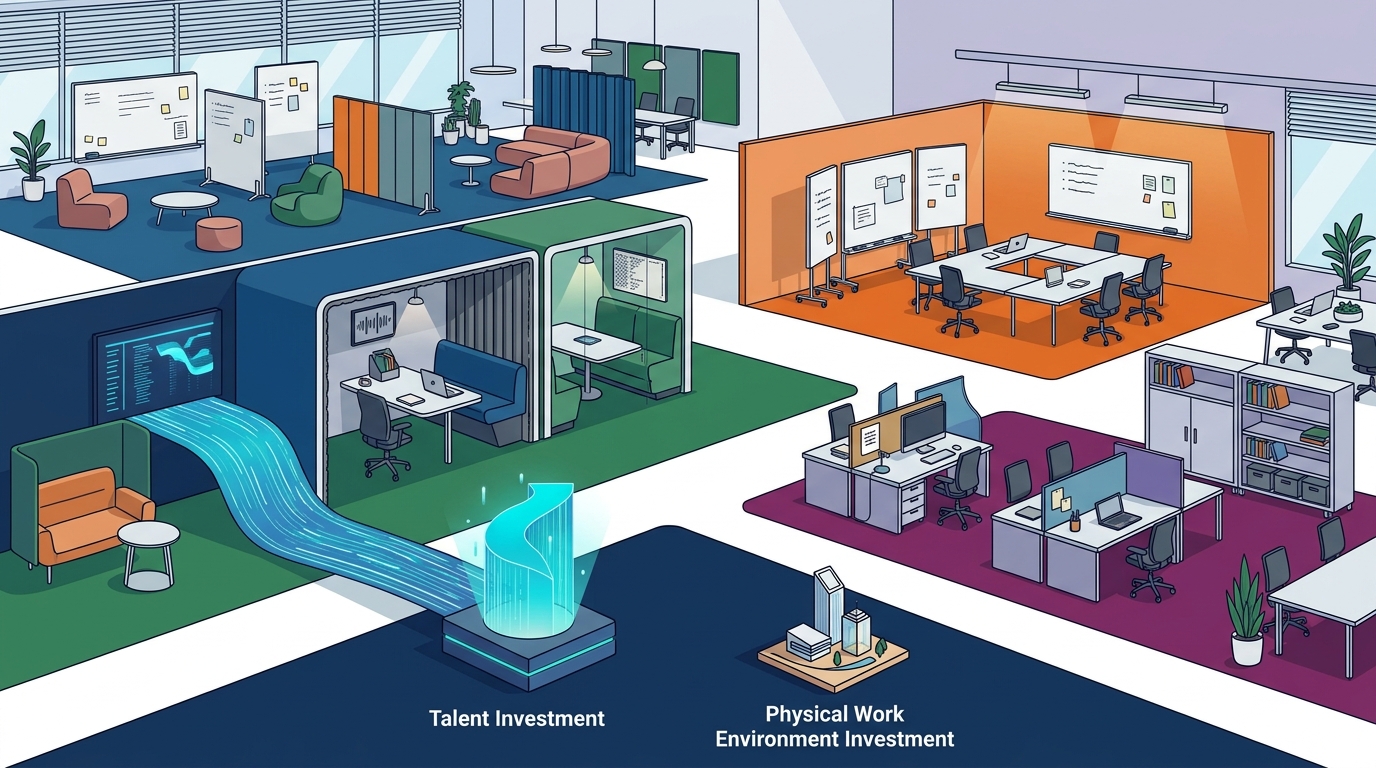
In knowledge-intensive organisations, roughly 75 % of operating costs go to talent and only about 5 % to the physical work environment. Yet that small 5 % determines how effectively the larger 75 % operates. This is what WIAR calls the leverage principle: strategically optimising the workplace unlocks the full potential of your people.
Many offices are unconscious sources of waste — lost time from noise, reduced focus from poor indoor climate, and inefficient circulation routes. When these friction points are resolved, the marginal investment in real estate translates into exponential gains in human capital through lower absenteeism, sharper concentration, and streamlined processes.
Research confirms the urgency. Steelcase's 2025 Futures research found that 70 % of organisations already have — or plan to move to — higher-tier properties, with the explicit goal of creating high-performing spaces that provide an elevated experience and support productivity and adaptability. The so-called flight to quality is not cosmetic; it is strategic.
2. Purposeful Zoning — Districts, Not Desks
A high-performing office is not a single-mode space. Steelcase's Community-Based Design approach reimagines the workplace as a dynamic ecosystem based on principles from urban planning, with distinct “districts” that support different kinds of work — from collaboration and learning to rejuvenation and focused tasks. This methodology treats employees as members of a community who have choice and control over where and how they work.
In practice, purposeful zoning means dedicating areas for:
- Deep-focus work — acoustically shielded rooms with soft lighting and neutral tones.
- Collaborative hubs — informal seating clusters, writable surfaces, and easy video-conferencing access.
- Regeneration zones — lounge areas, greenery, and access to daylight for mental recovery.
- Social connectors — café-style spaces that encourage the spontaneous interactions that drive innovation.
Data from Cushman & Wakefield underscores the shift: meeting-room bookings have surged globally — up 24.5 % in APAC, 22.0 % in the Americas, and 17.4 % in EMEA — showcasing a decisive move toward collaboration-focused workspaces. Any high-performance layout must accommodate this rising demand without starving focus work of the quiet it needs.
3. Indoor Climate and Cognitive Performance
Indoor environmental quality is perhaps the most underestimated lever for performance. Research from the Harvard T.H. Chan School of Public Health found that employees working in green-certified buildings show a 26 % increase in cognitive function and a 30 % reduction in sick days. Those are not marginal improvements — they are step-changes in organisational capability.
The critical variables include:
- Air quality — CO₂ levels, ventilation rates, and particulate filtration directly affect decision-making speed and accuracy.
- Lighting — circadian-responsive lighting systems keep employees alert during work hours and support natural sleep rhythms.
- Thermal comfort — personal climate control reduces complaints and sustains concentration through the day.
- Acoustics — speech-privacy indices and background masking prevent the attention fragmentation that open plans notoriously cause.
Investing in advanced air filtration, circadian lighting, and sound-masking systems is one of the highest-ROI moves a facilities team can make.
4. Flexibility Without Chaos
Hybrid work raised the bar — offices must now deliver meaningful experiences while reflecting organisational values and culture. But flexibility only works if it is managed. A decade ago, most offices were built around a one-to-one desk-to-employee ratio. Today, most organisations plan for 2:1 or higher workstation-sharing ratios, which requires deliberate systems for booking, wayfinding, and team coordination.
High-performing workplaces increasingly rely on automated desk and room booking, real-time occupancy data, and intelligent scheduling to make shared environments frictionless. Without such systems, employees lose confidence that their arrangements will be taken care of — and they resent coming to the office.
Flexibility also means the furniture and infrastructure adapt. Mobile partitions, height-adjustable desks, modular meeting pods, and plug-and-play AV ensure every square metre can shift from one mode to another in minutes, not months.
5. Return on Commute — Earning Every Journey
A defining metric for 2025 centres on making the office worth the trip, often referred to as Return on Commute. Successful office spaces deliver experiences unavailable at home — from café-inspired collaboration zones to quiet focus areas and meaningful community connections. Organisations that create engaging destinations see higher in-person attendance and increased employee satisfaction.
This means the office must be anticipatory and engaging, earning every commute every day. Spaces that engage all the senses and anticipate your needs — whether you are in a great mood or having a rough day — are the ones people return to willingly.
Practical examples include: arrival experiences with quality coffee and concierge-style tech support; bookable project rooms with persistent whiteboards for multi-day sprints; rooftop terraces or courtyard gardens for walking meetings; and on-site wellness amenities such as meditation rooms and fitness corners.
6. Sustainability as a Performance Driver
Sustainability in office design has become more than a trend — it is a business necessity. Buildings are responsible for nearly 40 % of global CO₂ emissions, according to the World Green Building Council, making every workplace renovation an opportunity to reduce an organisation's carbon footprint.
Biophilic design — incorporating natural elements like plants, wood, and water — is increasingly popular not only for its environmental benefits but also for enhancing employee well-being. Meanwhile, flexible offices are more sustainable by nature and more inclusive by design, offering environments that can meet a wide range of needs.
From energy-efficient HVAC to circular furniture procurement, a sustainability-first approach signals organisational values to talent and clients alike — and frequently reduces operating costs by 25–40 %.
7. Culture, Purpose, and Belonging
The physical environment is the most visible artefact of organisational culture. According to a National Workplace Trends Study, 80 % of workers say having a sense of purpose at work is essential for job satisfaction, and 89 % say feeling like part of a team is critical. High performers are drawn to environments that “feel right” — not to generic, cookie-cutter offices.
Translating culture into space means:
- Embedding brand narrative into material choices, colour palettes, and wayfinding graphics.
- Providing visible leadership presence — open leadership zones rather than corner offices.
- Creating ritual spaces for all-hands meetings, onboarding ceremonies, and team celebrations.
- Offering learning and development areas, mentorship corners, and innovation labs that signal investment in growth.
When the workplace physically embodies organisational values, it reinforces them every hour of every working day.
Key Takeaways
- The office is a lever, not a cost. A small percentage of budget in workspace optimisation amplifies the performance of your entire talent pool.
- Zone for variety. Districts for focus, collaboration, regeneration, and socialising prevent the one-size-fits-all trap.
- Prioritise indoor climate. Air quality, lighting, acoustics, and thermal comfort have measurable effects on cognitive function and health.
- Systematise flexibility. Shared desking only works with automated booking, real-time data, and modular furniture.
- Earn the commute. Every element of the office should offer something that remote work cannot replicate.
- Lead with sustainability. Green design reduces costs, attracts talent, and improves well-being simultaneously.
- Encode culture in space. Purpose-driven design boosts satisfaction, retention, and team cohesion.
Frequently Asked Questions
What is a high-performance workplace?
A high-performance workplace is a strategically designed office environment that measurably enhances productivity, well-being, and collaboration. Rather than treating the office as a cost centre, it functions as a management instrument — optimising processes, reducing waste, and unlocking the full potential of knowledge workers.
How much does a workplace transformation cost?
Costs vary widely depending on scope, location, and condition of existing premises. However, specialist partners like WIAR typically achieve 25–40 % reductions in investment and operating costs through independent procurement and process optimisation, ensuring every euro delivers maximum value.
Does office design really affect productivity?
Yes. Harvard research shows green-certified buildings boost cognitive function by 26 % and reduce sick days by 30 %. Acoustic, lighting, and air-quality interventions all have well-documented effects on focus and output.
What is ‘Return on Commute’?
Return on Commute is a design philosophy that asks whether every element of the office justifies the employee's journey. It drives decisions around amenities, experience design, and collaboration infrastructure — ensuring the office delivers value that remote work cannot.
How do you balance open-plan collaboration with quiet focus work?
Through purposeful zoning. The best-performing offices create distinct districts — collaboration hubs, deep-focus rooms, regeneration lounges, and social connectors — so employees can move fluidly between spaces based on the task at hand.
Why is sustainability important for office performance?
Sustainable features such as biophilic design, advanced air filtration, and energy-efficient systems directly improve occupant health and cognitive performance. They also reduce operating expenses and help attract talent that values corporate responsibility.